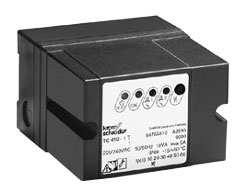


Valve Proving Controls TC 410
The tightness control TC checks the fail-safe function of both valves before each start-up or after each shut-down of a system with two safety valves.
The TC checks for leaks in both valves of a double valve system. If it identifies an inadmissible leak in one of these gas valves, it will prevent both from opening.
It is used in industrial thermoprocessing equipment, in boilers, and forced air burners.
European standards EN 746-2 and EN 676 stipulate tightness controls for capacities over 1200 kW (NFPA 86: from 117 kW or 400,000 Btu/h in conjunction with a visual indicator). Pre-purge of the combustion chamber can be dispensed with under certain conditions in accordance with EN 746-2, if a tightness control is used. In this case, the system must be vented into the open air.
TC 1
Tightness control TC 1 can be directly mounted to all CG combination controls. There is only one version for all sizes. The pre-set test period applies to all CG variants. In addition, TC 1 can be used for Valvario controls VAS, VAD and VAG (with separate adapter plate).
TC 2 and TC 410
Tightness controls TC 2 and TC 4 can be used with gas solenoid valves of any nominal size, which are quick opening or slow opening with start rate. It is possible to conduct a tightness test on pneumatically operated or slow opening valves without start rate by using additional auxiliary valves.
TC 410
Tightness control TC 4 consists of detection circuitry and can be installed in the control cabinet, separately from the system. An external pressure switch takes over the mechanical pressure test between the valves. Tightness control TC 4 is independent of gas type and inlet pressure pe and can be used for a test period of up to 10 minutes with a large test volume.
TC 3
Tightness control TC 3 is a universal device for quick and slow opening gas solenoid valves of any nominal size as well as for motorised valves. The tightness test is carried out with the valves installed in TC 3.
Features
- Test of both safety valves
- Short test period thanks to logical decision-making in the program sequence
- Adjustable test period which can be adapted to different systems
- Adjustable test mode allows quick system start
- Maximum safety thanks to self-monitoring electronics
- Less space required thanks to small dimensions
- EC type-tested and certified
- FM and UL approved
 |
Documentation
Manufacturer's Product Brochure Manufacturer's Operating Instructions Manufacturer's Technical Sheet |
| |
 |
Ordering Information
| Model |
TC type |
Mounting |
Test Period |
Price
(US List) |
Order Now |
| TC 410T-1N |
4 |
control cabinet installation |
10 to 60 s |
$396 |
 |
| TC 410T-10N |
4 |
control cabinet installation |
100 to 600 s |
$396 |
 |
|
| |
 |
Applications
Click on images for close-up view.
 |
TC 4 with two gas solenoid valves
Tightness control TC 4 checks gas solenoid valves V1 and V2 for
tightness.
The external pressure switch monitors the pressure between the two valves.
Once the tightness test has been carried out successfully, the tightness control forwards the OK enable signal to the automatic burner control unit GFA. The pilot valve output of the automatic burner control unit GFA opens the gas solenoid valves V1 and V2 simultaneously. The burner starts.
V1 and V2: quick or slow opening valves with start rate. |
 |
TC 4 in a multiple burner system with one auxiliary valve for discharge
Tightness control TC 4 checks the central shut-off valve V1, the auxiliary valve V2 and several burner valves for tightness. The external pressure switch monitors the pressure between the gas solenoid valves V1, V2 and the burner valves.
Once the tightness test has been carried out successfully, TC 4 opens gas solenoid valve V1. The tightness control forwards the OK enable signal simultaneously to the automatic burner control units for the burner valves. The burner valves open and the burners start.
Thanks to the relief line and auxiliary valve V2, the test volume is discharged into the open air via the roof or into the combustion chamber.
V1: quick opening valve.
V2: quick opening, minimum nominal size = DN 15. |
 |
TC 4 in a multiple burner system with two auxiliary valves for supply and discharge
Tightness control TC 4 checks the central shut-off valve V1, auxiliary valves V2 and V3, and several burner valves for tightness.
The test volume is supplied via the auxiliary valve V2.
The external pressure switch monitors the pressure between the gas solenoid valves and the burner valves.
Once the tightness test has been carried out successfully, TC 4 opens the central shut-off valve V1. The tightness control forwards the OK enable signal simultaneously to the automatic burner control units for the burner valves. The burner valves open and the burners start.
Thanks to the relief line and auxiliary valve V2, the test volume is discharged into the open air via the roof or into the combustion chamber.
V1: any.
V2 and V3: quick opening, minimum nominal size = DN 15. |
 |
TC 4 with 3 valves installed in series
Tightness control TC 4 checks the central shut-off valve V1, the gas solenoid valve V2 and the auxiliary valves V3 and V4 for tightness.
The test volume is supplied via the auxiliary valve V3. The central shut-off valve V1 can thus also be a slow opening motorised valve VK. The test volume is discharged via auxiliary valve V4 and the relief line.
It must be ensured that the test volume can be supplied and discharged during the opening time of the gas solenoid valves. Therefore, the pressure switch DG monitors the pressure downstream of the gas solenoid valve V2 and switches when the set pressure is exceeded. Then the gas solenoid valve VAS opens and the pipe downstream of V2 is vented.
Once the tightness test has been carried out successfully, the tightness control TC 4 opens the shut-off valve V1 and gas solenoid valve V2. The tightness control forwards the OK enable signal simultaneously to the automatic burner control units. These open the burner valves and the burners start.
V3 and V4: quick opening, minimum nominal size = DN 15. |
|
| |
 |
Specifications
| General Specifications |
| Mains voltage: |
110/120 V AC, -15/+10 %, 50/60 Hz
220/240 V AC, -15/+10 %, 50/60 Hz
24 V DC, ± 20% |
| Power consumption: |
10 VA for 110/120 V AC and 220/240 V AC,
1.2 W for 24 V DC. |
| Ambient temperature: |
-15 to +60°C (+5 to +140°F), no condensation
permitted.
2.5 mm2 screw terminals. |
| Fusing: |
fine-wire fuse 5 A, slow-acting, H pursuant
to IEC 127, also protects the valve outputs
and external operating signal. |
| External operating signal: |
with mains voltage, max. 5 A resistive load
(UL approved: 5 A for 120 V),
max. 2 A for cos φ = 0.35 (pilot duty). |
| External fault signal: |
fault signalling contact, max. 5 A for 264 V |
| Reset: |
using a button on the device |
| Remote reset: |
by applying mains voltage |
| Housing: |
impact-resistant plastic |
| Gas type and inlet pressure pe: |
Dependent on external pressure switch |
| Pressure Switch: |
The pressure switch is set to half the inlet
pressure pe/2. The switching differential
may not exceed ±10% of the set switching
pressure. |
| Test period tP: |
TC 410-1: 10 to 60 s, adjustable:
set at the factory to 10 s. |
| TC 410-10: |
100 to 600 s, adjustable:
set at the factory to 100 s. |
| Enclosure: |
IP 40 |
| External fault signal: |
dry contact (not internally fused),
max. 1 A for 264 V, max. 2 A for 120 V |
| Connections: |
Lower section with connection terminals.
5 knock-out holes for PG 11 cable gland or
M16 plastic cable glands are pre-prepared. |
| Maintenance cycles: |
The tightness control requires little servicing. We recommend a function check once
a year. |
|